
September may be here, but Japan is still under the glare of some truly intense sunshine day after day. How have all our SWS Brothers been doing?
Please be sure to keep yourself hydrated and take good care of your health.
Now then, in this edition of the Old Man Blog, I will be taking you through every part included in the newly released SWS 1/32 Type 5 Fighter.
What’s that? You have already started building the kit...?!
Ah yes, of course. If you were lucky enough to pick up the Type 5 Fighter kit at the recent IPMS Nationals in Fort Wayne, USA, your build may already be coming along at quite a pace.
And here in Japan as well, the kits sold in advance to customers with reservations are surely taking shape, one by one, in the hands of the fans who had been waiting so eagerly for them.
So, what do you think of the Type 5 Fighter kit? I sincerely hope you are enjoying it to the fullest.
Goodness me!
Purchases have far exceeded anything we imagined, and I, the Old Man of Zoukei-Mura, along with everyone on the kit development team, would like to express our heartfelt gratitude. Thank you very, very much.
Speaking of IPMS...
It has already been 15 years since Zoukei-Mura, still finding its feet, first carried that unusual 1/32 Shinden kit to the UK IPMS event held every November and set up the smallest of booths.
Of course, attending a world-class event also gives us an invaluable opportunity to see and study, with our own eyes, rare aircraft that can only be found in British aviation museums.

▋And here comes the star of the show at last!
Can you believe it? A chance to see a real Ki-100—the final fighter of the Japanese Army—right up close!
For a while, I just stood there, completely lost for words as the emotion thundered through my chest.
My heartfelt thanks to everyone at the Royal Air Force Museum for restoring this precious aircraft with such care!
Then came the fateful year of 2011!
After exhibiting at IPMS in Telford, UK, for the very first time with a Zoukei-Mura booth, I visited the Royal Air Force Museum at Cosford—and, by a stroke of wonderful fortune, unexpectedly came face to face with a Type 5 Fighter undergoing restoration.
There it was, quite literally: my beloved Japanese aircraft, the Type 5 Fighter, stripped completely bare, revealing moment by moment the very process of its rebirth.
Then one of the restoration staff noticed that we appeared to be Japanese, beckoned us over, and to our amazement allowed us into the work area. To that person from back then—thank you~~~ thank you~~~
And having even been granted permission to take photographs, we became a mysterious group of Japanese visitors taking photo after photo. Secretly, I even reached out and gently ran my hand over the propeller and parts of the airframe.
The feel of that remarkably thin duralumin—so characteristic of Japanese aircraft produced near the end of the war—seemed to convey all the earnest effort poured into it, and tears of gratitude and emotion welled up in my heart.
Even amid wartime shortages, every bolt, nut, and rivet seemed to bear the marks of the factory workers’ careful craftsmanship. I was left speechless.
Coincidence though it may have been, as I stood before that precious Japanese aircraft being restored in a British museum, one thought welled up inside me: Someday, I swear, I will bring you back as a plastic model kit. Please wait for me until then.
That was the bittersweet feeling that rose within me.
Fifteen years have passed since then. At long last, that day has arrived.
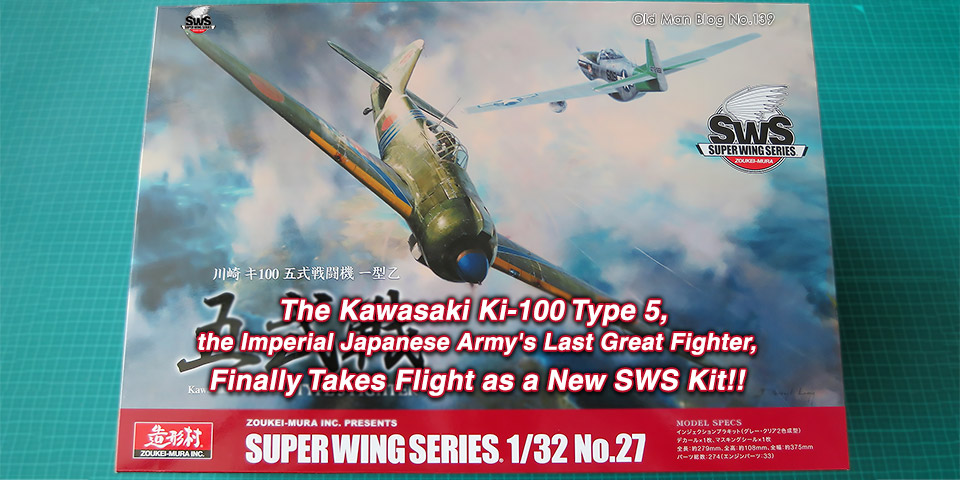
Yes indeed. At long last, Zoukei-Mura’s SWS 1/32 Kit No. 27, the “Type 5 Fighter,” has taken flight into the world of scale models as a plastic model kit.
To the Royal Air Force Museum Cosford, which so magnificently restored this Japanese Army Type 5 Fighter, we offer our deepest gratitude and heartfelt respect.
And to every one of our SWS Brothers who has welcomed this kit into their collection—thank you so very much~~
And to those of you who are still thinking about adding this Type 5 Fighter to your collection—there is no need to hesitate any longer.
With unprecedented detail and excellent ease of assembly, this kit represents the very pinnacle of the SWS series. Whether this is your first SWS kit or your first Japanese aircraft, I can recommend the Type 5 Fighter to you with complete confidence and from the bottom of my heart.

▋Just as you would expect from the latest SWS kit, take a good look at how sharply each part is finished.
Especially those crisp trailing edges on the propeller blades.
And of course, we did not cut any corners on the nose cowling, armor plate, or propeller spinner either.
Naturally, these parts snap together with a crisp, satisfying fit, drawing that unmistakable Ki-100 shape right before your eyes.

▋And here, the molded detail on the upper and lower wing surfaces really shows the results of our research on the actual aircraft, doesn't it?
But if you want to show off the wing structure, leave the upper wing panels unglued and make them removable. Then you can check out the finely reproduced spar layout and the way the machine guns are installed.
The gun ports on the top of the fuselage are nicely reproduced too.

▋This runner gives you the fuselage structural frames, landing gear, tires, and drop tank.
They are all pretty small parts, so careful, precise work is the order of the day.
Use a sharp pair of nippers, but don’t cut right up against the part. Leave just a little gate on the part side when you remove it.
The fuselage interior in particular follows the structure of the actual aircraft, so you can enjoy a truly fascinating build.

▋Look here—the main spars for both wings are neatly made into separate parts.
Since they are such great parts, why not build the model so you can see them without attaching the outer skin? You will also get a clear look at how the machine guns are mounted.

▋Now then, here come the Ha-112 engine parts—the very engine that gave the Ki-100 its character.
The intake pipes and collector exhausts are beautifully finished as well.
This is where your painting skills really get to shine.
Once it is finished, the engine alone has more than enough presence to enjoy all by itself.
That, my friends, is the real joy of an SWS kit.

▋A runner packed with delicate parts like this calls for extra care and a very steady hand.
For cables and piping, you can also use fine lead wire or nylon fishing line. If you want to take the finish up another notch, give these extra materials a try.

▋Let’s keep going, shall we?
Here we have the parts for the various sections laid out.
Just follow the instruction manual, test-fitting as you go, and enjoy the build.


▋That brings us through all the parts for the airframe sections.
You can see the machine guns, ailerons, vertical tail, and more right here.
Apart from the canopy, instrument panel, navigation lights, and the like, all the parts for the Ki-100 Type 1 Otsu are now here.
In the closing days of the war, those many “headless” airframes sitting forlornly on the apron at the Kawasaki Aircraft factory suddenly showed unexpected performance. And now, at long last, the time has come for you to recreate the scene of them taking to the skies as the true stars of the Imperial Japanese Army Air Service.
A big round of applause for you and your courage to take it on~~~!

▋And here are the clear parts for the Ki-100 with the teardrop canopy, the hallmark of the Otsu type.
The instrument panel is clear too, so you can give each gauge that glass-like look.
Please, please be careful not to lose those tiny navigation light and wingtip light parts!
If one of those little parts goes flying when you cut it free, I search for it while making a “bata-bata-bata” sound with my mouth, just like a crewman in a scout helicopter imitating a descending hover.
Strange as it may sound, it seems to raise the chances of finding the part safe and sound. So if you are alone, do give it a try—just once—as if I had fooled you into it.
Bata-bata-bata-bataaa~~~

▋And finally, here come the decals for the Ki-100.
With these markings, you can bring back fascinating wartime Ki-100 subjects, including the aircraft of Major Yohei Hinoki, who was hit in combat with a P-51, lost one leg, fought on bravely, returned safely to his unit, and continued to serve until the end of the war, as well as the aircraft of the commander of the 5th Air Regiment.
That is the kind of Japanese aircraft collection you can enjoy with SWS.
Of course, this kit also comes with masking tape complete with pre-cut guide lines just for painting the canopy.
That stuff sure is handy, isn’t it?
The legendary aircraft that closed the chapter on Japanese Army fighters is reborn at last.
Plastic parts: 274 pieces; decals: 1 sheet; canopy masking sheet: 1 sheet; assembly instruction manual: 1 booklet.
Based on the latest research into the aircraft preserved at the Royal Air Force Museum Cosford, the striking Type 5 Fighter is finally ready to take its place in your aircraft model collection.
We warmly invite you to experience the true essence of an aircraft collection kit, recreated in that magical material we call plastic.
Hideyuki Shigeta
President, Zoukei-Mura






































































































































































































 Old Man Blog No.139
The Kawasaki Ki-100 Type 5, the Imperial Japanese Army's Last Great Fighter, Finally Takes Flight as a New SWS Kit!!
Old Man Blog No.139
The Kawasaki Ki-100 Type 5, the Imperial Japanese Army's Last Great Fighter, Finally Takes Flight as a New SWS Kit!!